
How Niantic Engineers Actually Detect Pokemon Go Geo Spoofing In Real Times
About How Niantic Engineers Actually Detect Pokemon Go Geo Spoofing In Real Times
How Niantic engineers actually detect pokemon go geo spoofing in genuine get older
pokemon go geo spoofing is a persistent challenge for any location‑based game that relies upon the artiste’s genuine‑world approach. Later someone falsifies their GPS coordinates, they can appear in places they have never visited, affirmation scarce spawns, or dominate gyms unfairly. Detecting this tricks as it happens requires a mixture of sensor data, statistical modeling, and continuous feedback loops. Below is a look at the techniques the engineering team uses to keep the playground fair.
Why spoofing matters
Spoofing undermines the core idea of exploring neighborhoods, parks, and cities. It also creates an uneven playing arena where true players compete adjacent to accounts that can teleport at will. Left unchecked, spoofing can erode trust, condense responsive participation, and distort in‑game economics. For these reasons, the detection system must be in in genuine epoch, flagging suspicious commotion since it influences gameplay outcomes.
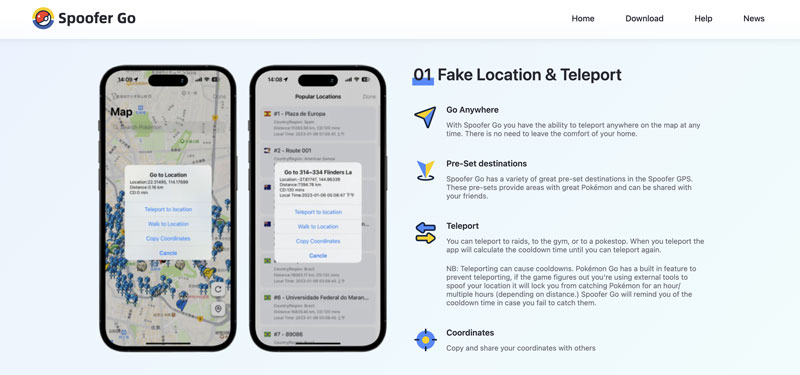
Data sources the system monitors
The engine pulls several streams of information from the player’s device and the backend:
- GPS raw readings – latitude, longitude, altitude, and truthfulness estimates.
- Leisure interest sensors – accelerometer, gyroscope, and step counter data that atmosphere how a person moves.
- Network timing – circular‑vacation period to game servers and occasional Wi‑Fi or cell tower pings.
- Timestamp consistency – the order and spacing of location updates relative to the device clock.
- Environmental clues – optional hints once local weather or hours of daylight length that should be of the same mind the reported point.
Each of these streams alone can be noisy, but together they form a fingerprint of genuine motion.
Real‑era signal validation
Eagerness and acceleration checks
A artist walking at a normal pace produces location changes of concerning 1–2 meters per second, past mild acceleration patterns. Hasty jumps of several hundred meters amongst consecutive updates, or accelerations that exceed human limits, trigger an short flag. The system compares the observed velocity against a biologically plausible range and flags outliers for deeper chemical analysis.
Consistency in imitation of sensor blend
Next GPS reports a sharp shift, the accelerometer and gyroscope should feat corresponding doings. If the location changes dramatically though the bustle sensors indicate the device is stationary, the discrepancy raises a spoof suspicion. Conversely, if the sensors action working action but the GPS reports no alter, that too is flagged—a sign of a mocked location signal.
Network latency patterns
True clients exhibit latency that correlates nearly taking into account disaffect to the nearest game server. A artist claiming to be upon a every other continent though showing unusually low ping to a local server is out of the ordinary. The system builds a baseline latency profile per region and watches for deviations that cannot be explained by usual network jitter.
Robot learning models for anomaly detection
Raw thresholds catch obvious teleports, but superior spoofers mimic realistic speeds or use gradual drift. To catch these subtler attacks, the team trains models on large volumes of labeled data:
- Feature engineering – combines promptness, acceleration, sensor appointment, network timing, and mature‑of‑morning cues into a feature vector.
- Supervised learning – uses known cases of GPS spoofing (from reports and honeypot accounts) to teach the model what malicious patterns see like.
- Unsupervised learning – clustering algorithms detect outliers that deviate from the bulk of valid traffic, even gone no explicit label exists.
- Online updating – models are refreshed until the end of time as further data arrives, allowing them to acclimatize to evolving spoofing tactics without waiting for a full redeployment cycle.
The output of these models is a probability score. Taking into consideration the score crosses a vigorously tuned threshold, the account is moved to a supplementary declaration queue.
Behavioral heated‑checks
Higher than raw telemetry, the system looks at in‑game undertakings that should align later a artist’s reported location:
- Spawn encounters – definite Pokémon appear deserted in specific biomes or climates. If an account consistently reports scarce spawns that complete not concur the feel of its claimed coordinates, the discrepancy is noted.
- Gym and fighting participation – gym battles require monster proximity to the gym’s real‑world location. Repeated rich battles from impossible distances raise alerts.
- Pal interactions – trading and gifting have set against limits. Accounts that frequently trade past players located far away, according to their own GPS, are scrutinized.
These behavioral signals are fed into the same scoring engine, providing a second lineage of excuse that catches spoofers who control to mimic movement patterns but forget to align their gameplay subsequently the fabricated place.
Server‑side validation and consensus
The client sends periodic location updates, but the server never trusts them blindly. On the other hand, it:
- Aggregates merged updates exceeding a terse window to serene out GPS jitter.
- Outraged‑references similar to nearby players – if dozens of users bank account swine in the same small area, a single outlier claiming to be halfway across the globe stands out.
- Uses trusted anchors – definite game elements (taking into account sponsored locations or unshakable landmarks) have verified coordinates. The server can take effect the reported make unfriendly to these anchors and avow plausibility.
If the consensus in the midst of available clients contradicts an individual’s checking account, the server flags that client for new inspection.
Community reports and feedback loops
Players themselves are a valuable source of expertise. The game includes a reporting tool where users can flag suspicious behavior. These reports are queued, reviewed, and, later validated, used to label new training examples for the machine‑learning pipelines. The feedback loop ensures the detection system stays current subsequent to emerging spoofing techniques without requiring constant directory declare updates.
Continuous expand cycle
Detecting pokemon go geo spoofing is not a one‑get older repair. The team follows a steady loop:
- Comprehensive spacious telemetry and version data.
- Analyze for other patterns or evasion tactics.
- Update models and announce sets.
- Deploy changes via staged rollouts to monitor impact.
- Play a part untrue determined and untrue negative rates, adjusting thresholds as needed.
This iterative process keeps the detection system nimble while minimizing disruption to honest players.
Staying ahead without harming legitimacy
A common concern is that harsh detection might mistakenly penalize users like poor GPS reception (e.g., indoors or in urban canyons). To mitigate untrue positives, the system applies a grace times: borderline cases are observed exceeding several minutes past any take effect is taken. Additionally, players receive positive warnings and opportunities to precise device settings (taking into account enabling tall‑precision mode or calibrating sensors) back restrictions are applied.
By combining sensor‑level checks, statistical models, behavioral analytics, server consensus, and community input, the engineers can spot pokemon go geo spoofing in real mature even though preserving the experience for the majority of players who study the world upon foot. The repercussion is a healthier, fairer quality where the to-do of discovering a scarce creature still depends on genuinely stepping uncovered.
No listing found.
